How long do balloons last? It sounds like a simple question. A client calls you up and asks exactly that, and suddenly you’re doing mental math involving balloon size, inflation method, room temperature, whether it’s indoors or outdoors, and whether you will need to treat them — all while trying to sound confident on the phone and not make everything sound too complex and confusing for the client.
The truth is, there’s no single answer. A 5-inch latex balloon filled with helium might float less than an hour. A Hi-float treated 12-inch round filled with air in a climate-controlled gallery can look good for up to five months. Same material, wildly different lifespans. The difference comes down to understanding what actually makes balloons deflate — and what you can do about it.
This guide covers float times for every common balloon size filled with helium and lifespan for air-filled decor, with and without treatment. Whether you’re quoting a Saturday afternoon party or planning a month-long balloon art installation, the information here should help you give your clients honest, accurate answers.
Why Do Balloons Deflate?
Latex is a natural material — it’s essentially tree sap. And like basically all natural materials, it’s porous. On a microscopic level, latex is full of tiny gaps, and gas molecules slowly migrate through those gaps over time. Helium atoms are exceptionally small (they’re the second-smallest element), which is why they escape through latex much faster than air (mostly composed of much larger nitrogen and oxygen molecules) does. That’s the fundamental reason helium balloons go soft overnight while air-filled balloons can last for weeks.
Three main factors accelerate this process:
Temperature. Heat makes the gas inside expand, stretching the latex and opening up those microscopic pores even further. A balloon that would last 12 hours in an air-conditioned room might last less than 4 hours at an outdoor summer event. Conversely, cold temperatures make balloons shrink and appear under-inflated — they’ll look like they’re deflating even though they’ll bounce back when they warm up.
UV exposure. Sunlight breaks down the polymer chains in latex, making it brittle and accelerating oxidation (creating that chalky, matte appearance). Direct sun is the single biggest enemy of latex balloon longevity – and this is also affected by the color of balloons. Dark colors are worse in direct sunlight and they may not handle more than a few minutes of the sun exposure.
Inflation level. An over-inflated balloon is under more internal pressure, which pushes gas out through the pores faster. Also, the over (or fully) inslated balloon has thinner layer of latex and the pores are stretched larger. This is why experienced decorators slightly under-inflate for events where longevity matters — this makes balloons to last significantly longer. Another tip for especially outside installs is to first fully inflate balloons, to sofen the latex, then deflate. This makes balloons to withstand the temperature changes much better when the latex is in more “relaxed state”.
🔬 The science behind it: how much faster does helium escape?
The effective size of a gas particle is often described by its kinetic diameter — an experimentally derived quantity that reflects how large the particle effectively behaves when colliding with other molecules or moving through very small spaces. A helium atom has a kinetic diameter of about 260 picometres (pm). A nitrogen molecule — the main component of air — measures 364 pm, and oxygen is 346 pm.
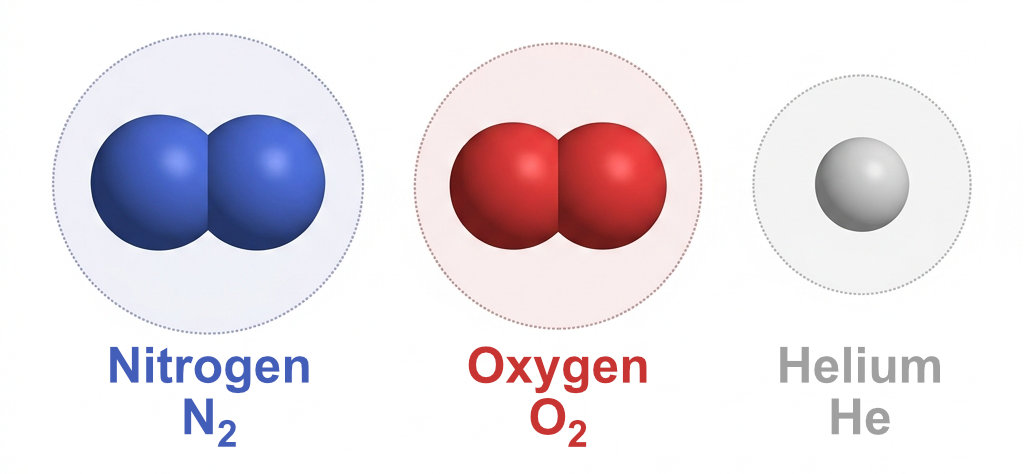
That might not sound like a dramatic difference, but gas permeation through rubber depends on two factors: diffusivity (how fast the molecule moves through the material) and solubility (how readily the gas dissolves into the rubber). Together, these determine permeability. For helium in latex, diffusivity is the dominant factor — and diffusivity through polymers is much more sensitive to molecular size than a simple linear relationship would suggest. The process, known in polymer science as solution-diffusion, works in three steps: gas dissolves into the latex surface, migrates through transient gaps between the polymer chains (called “free volume”), and exits on the other side. Smaller molecules navigate those gaps far more easily.
Measured permeability data for natural rubber shows that helium’s permeability is approximately 3–5 times greater than nitrogen’s. But if the material property only differs by 3–5×, why do helium balloons lose buoyancy within a day while air-filled balloons often stay inflated for weeks?
The answer lies in the partial-pressure gradient. A helium balloon initially contains almost pure helium, while the surrounding atmosphere contains virtually none — creating a large driving force for helium to diffuse outward. By contrast, an air-filled balloon is surrounded by air of nearly the same composition, so the only significant driving force is the small excess pressure created by the stretched latex. As a result, helium experiences both a higher permeability and a much larger diffusion driving force, producing a substantially greater outward flux through the latex wall.
A small amount of nitrogen and oxygen also diffuses into the balloon from the surrounding air, but this effect is minor compared with the rapid loss of helium. The balloon therefore shrinks as helium escapes, while its buoyancy decreases even slightly faster.
Helium-Filled Latex: Realistic Float Times
Let’s get specific. The table below is based on manufacturer’s published specifications and our own experience working with professional-grade latex from Sempertex, Kalisan, and Tuftex. These are indoor float times at normal room temperature (around 20°C / 68°F). Budget balloons from party stores or for example from Amazon will underperform these numbers — sometimes dramatically.
| Balloon Size | Float Time (Untreated) | Float Time (with Hi-Float) |
|---|---|---|
| 5″ (13 cm) | Very limited | Not recommended |
| 9″ (23 cm) | 10–14 hours | 3–7 days |
| 10″ (25 cm) | 12–16 hours | 5–10 days |
| 11″–12″ (28–30 cm) | 18–24 hours | 1–4 weeks |
| 18″ (45 cm) | 36+ hours | 3–8 weeks |
| 24″ (60 cm) | 2–4 days | 4–10 weeks |
| 30″ (75 cm, underinflated 36″) | 2–4 days | 4–16 weeks |
| 36″ (90 cm) | 3–5 days | 6–20 weeks |
| Heart 12″ (28 cm) | ~14 hours | 3–5 days |
| Link-O-Loon 12″ (29 cm) | 12–24 hours | 1–4 weeks |
| Link-O-Loon 660 | ~10 hours | 2–5 days |
Hi-Float treated times based on mostly our own experience. Actual flying times vary depending on temperature, atmospheric conditions, and treatment application quality (how uniform layer of Hi-float is, how much Hi-float is used etc.).
A few things worth noting when reading this table:
5-inch balloons simply don’t contain enough helium to generate meaningful lift. They will float for a short while, when fully inflated with pure helium, but the float time is very limited. You’ll see 9″ and 10″ rounds used occasionally for small bouquets, but even those have limited float time — treat them if they need to last more than half a day. We don’t inflate anything smaller than 12″ balloons with helium.
The “with Hi-Float” column assumes proper application — not a quick squirt, but a full interior coating that’s been massaged evenly across the inside of the balloon before inflation. Sloppy application gives sloppy results. In our experience, the treatment quality matters more than the balloon brand once you’re using professional-grade latex. A perfectly treated Kalisan 12″ and a perfectly treated Sempertex 12″ will give you very similar float times. Sempertex may have a slight edge in some side-by-side tests, but the difference is small enough that your application technique matters more.
That said, the gap between professional brands and cheap, no-name balloons is sometimes enormous. Budget latex often has inconsistent wall thickness — some balloons from the same bag will last 18 hours while others may fail after 6 hours. With professional brands from Sempertex, Kalisan, or Tuftex, you get predictable results, and that’s what you need when a client is counting on you.
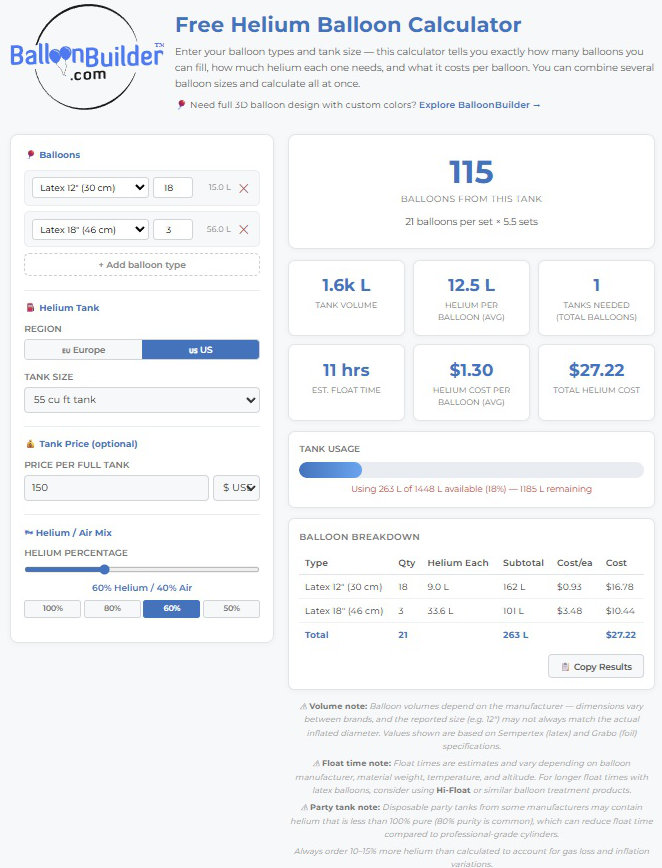
If you need to calculate how much helium you’ll need for a job, our free helium calculator can help you estimate tank requirements based on the sizes and quantities you’re using.
Air-Filled Latex: Where the Real Longevity Lives
Here’s where it gets interesting for decorators. Air-filled latex balloons last dramatically longer than helium-filled — we’re talking weeks instead of hours. Air molecules (mostly nitrogen and oxygen) are much larger than helium atoms, so they escape through the latex pores at a fraction of the rate.
In a climate-controlled indoor environment with no direct sunlight:
| Balloon Size | Untreated | With Hi-Float + Balloon Shine |
|---|---|---|
| 5″ (12 cm) | 1–3 weeks | 3–6 weeks |
| 11″–12″ (28–30 cm) | 3–6 weeks | 1–4 months |
| 16″–18″ (40–45 cm) | 4–8 weeks | 3–5 months |
| 24″ (60 cm) | 6–10 weeks | 5+ months |
| 36″ (90 cm) | 8–12 weeks | 5+ months |
These numbers might surprise people who only think of balloons as something you inflate the morning of a party. But professional decorators working on long-term installations — retail displays, office lobbies, exhibition pieces — rely on air-filled balloons lasting for weeks or even months.
It should be noted, that comparison of helium float time to air-filled lifespan is not a direct 1:1 comparison, since air-filled balloons will never float. With helium, there’s a clear moment of failure — the balloon stops floating. With air-filled designs, “how long do balloons last” is more subjective. The lifespan depends on when the balloons stop looking good, and that’s partly in the eye of the beholder. A balloon that’s lost 10–15% of its volume might look perfectly fine tucked into a tightly packed garland, where neighboring balloons support its shape. The same balloon on its own might look noticeably soft. Design matters: organic garlands and packed clusters are more forgiving than standalone columns or single-balloon features, because slight deflation is hidden by the surrounding structure.
The key factors that separate a balloon lasting 3 weeks from one lasting 4 months: treatment products (more on those below), stable temperature, no UV exposure, and balloon quality.
Modelling Balloons and Long-Duration Sculptures
Modelling balloons (twisting balloons) follow their own rules because of their shape — they have a much higher surface-area-to-volume ratio than round balloons, which means air escapes faster relative to their total volume. Small modelling balloons also have a higher internal pressure, which also speeds the escape of air or helium from the balloon.
That said, treated modelling balloons can still last impressively long:
260 balloons (the most common twisting size) treated with Hi-Float and balloon shine typically hold their shape for a maximum of 1–2 months in a controlled indoor environment. They’ll gradually lose firmness toward the end of that window, but they remain structurally intact. The lifespan of 260 balloon is also dependent on the way they are used: A single fully inflated 260 balloon will loose air much faster and will not look good after 1-2 months, even though the same balloon in a weaved/twisted design, where individual bubbles are much shorter (closer to round shape) will last much better.
360 and larger modelling balloons do better — expect 2–3 months or longer with treatment. The thicker latex and greater volume make a real difference. Also with 360 balloons, a fully inflated balloon will loose the air faster than a weaved/twisted balloon.
Larger round balloons (12″ and up) used as structural elements in sculptures can last 4–5 months or even longer when properly treated and kept in the right conditions.
These timeframes matter because of a trend that’s been growing rapidly in the last few years: large-scale balloon art exhibitions.
Balloon Art Exhibitions: Pushing the Limits
If you haven’t seen what’s happening in the world of immersive balloon art, it’s worth paying attention. Touring exhibitions like Balloon Story are bringing massive balloon installations to cities like Barcelona, Melbourne, and Sydney — immersive experiences built from hundreds of thousands of balloons that visitors walk through. These aren’t weekend pop-ups. They run for months at a time.
This is only possible because of the longevity of air-filled, treated balloons. These installations rely on professional-grade latex, interior sealant treatments (Hi-float), and exterior shine products (Hi-shine) to keep everything looking fresh over extended periods. Climate control is critical — they run in temperature-controlled venues, and the teams behind them do ongoing maintenance, replacing individual balloons as needed throughout each run.
For decorators, this growing trend opens up new business opportunities beyond traditional event work. Retail chains, museums, corporate lobbies, and event spaces are increasingly interested in semi-permanent balloon installations that last weeks or months. If you can master the treatment process and offer maintenance, you’re operating in a space with very little competition and strong margins.
Hi-Float and Interior Sealants: What Actually Works
Hi-Float has been the standard interior balloon sealant for decades. It’s a water-soluble polymer (polyvinyl alcohol, or PVA) that you squeeze inside the balloon and spread across the interior surface before inflating. The coating creates a barrier that dramatically slows gas migration through the latex — it’s the single most effective way to extend both helium float time and air-filled longevity.
The original Hi-Float patents have expired some years ago, which means the underlying technology is now in the public domain and several alternative products have entered the market during the recent years.
All work on the same principle. If you’re loyal to Hi-Float, there’s no reason to switch — it’s proven and reliable. But if availability or pricing is an issue in your market, the alternatives work mostly the same way.
Application matters more than brand. The number one mistake decorators make with sealant is rushing the application. You need to dispense enough product (but not too much) to coat the entire interior, then physically massage the balloon to spread it evenly before inflating. A quick squirt that only coats one side will give you partial coverage and inconsistent results. Take extra care when massaging the gel around the balloon – it makes a real difference over hundreds of balloons.
Balloon Shine: Keeping the Gloss
Oxidation is the enemy of appearance even when the balloon is still perfectly inflated. You’ve probably seen it — a few hours after inflation, latex starts to develop that dull, chalky appearance, especially on darker colors and chrome finishes. The balloon is fine structurally, but it doesn’t look “fresh”.
Balloon shine products address this with a thin silicone-based coating applied to the exterior of the balloon. The most common options:
- Hi-Shine — the companion product to Hi-Float, available in different types of spray bottles
- Balloon Shine – the “original” shine product, that requires you to spread it on top of the balloon
- Mega Shine — popular in some areas
- Balloon Glow — another well-regarded option
- Kalisan Instant Balloon Shine — similar to Mega Shine and Hi-Shine spray from Kalisan
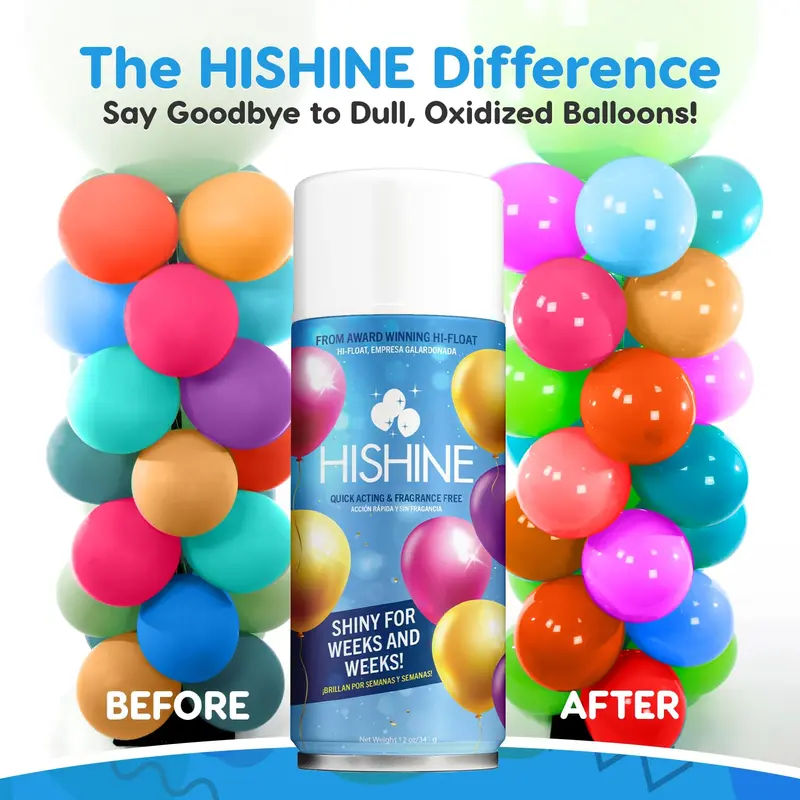
These products do two things: they restore and enhance the glossy appearance of the latex, and they create a barrier against UV-driven oxidation. For long-duration installations, they’re not optional — they’re essential – to keep the balloon sculptures look fresh. They also slightly extend the lifespan of scultures by slowing the oxidation, which eventually makes balloons weaker.
Some of the shine products require the user to spread the shine manually, while most new products spread on their own, once the balloon is sprayed with the product. Important thing especially with the new “spray-on” products is, that you don’t use too much of it, since it will start dripping and makes the surrounding area very slippery – also the spary in the air will eventually land on also other surfaces near the balloons – so make sure to cover any surfaces near the area when you spray the scultpures. Especially the floor is critical – the spray can make floor to be dangerously slippery after application.
For multi-week or multi-month installations, plan on re-applying shine if needed to maintain appearance.
Balloon Quality: Not All Latex Is Equal
This is worth its own section because it comes up constantly, and the differences are real.
The major professional balloon manufacturers include Sempertex (Colombia), Kalisan (Turkey, also at kalisan.com.tr), Tuftex (USA), and Latex Occidental (Mexico) — who manufactures both the well-established Globos Payaso brand and their newer Luma Balloons line, which is increasingly available in European and North American markets. All of these companies produce latex under controlled manufacturing conditions with consistent wall thickness, reliable sizing, and predictable performance.
Each brand has its own strengths. Sempertex has built a reputation for exceptionally consistent quality — their manufacturing tolerances and quality control systems make them a safe default choice for decorators who need predictable results. Tuftex, meanwhile, is widely regarded in the industry as the go-to brand for outdoor installations — their denser latex compound holds up particularly well against UV exposure and heat, which is why so many outdoor-focused decorators swear by them. Kalisan offers strong overall performance. And Latex Occidental’s brands (Globos Payaso and Luma) are well-established in the Latin American market and increasingly competitive internationally. Most decorators use the products that are available on their market and also the prices of different brands differ on different markets – mostly due to shipping distances and competition.
What separates professional latex from budget brands:
Wall thickness consistency. Professional balloons have uniform thickness across the entire surface and less so called “pinholes”, which are weaker spots on the surface of the balloons. Budget balloons often have thin spots where gas escapes faster, this may also affect the shape of balloons in extreme cases – leading to lopsided inflation or early popping. With lower-quality latex, you can have balloons from the same bag performing completely differently — one lasts ok, the next one leaks faster and deflates within minutes or hours after inflation.
Latex compound quality. Higher-grade natural rubber with better elasticity and UV resistance. This isn’t marketing — it’s measurable in durability testing.
Size accuracy. When a professional balloon says 12″, it inflates to 12″ consistently. However, the shapes of different brands of balloons differ slightly. Budget balloons might vary by an inch or more.
Color and finish range. Professional manufacturers offer a wide range of finishes — standard (including pastels, pastel matte, pastel dusk, and similar), satin, metallic, silk/aura, chrome/reflex/mirror/effects, transparent/clear, and neon — with consistent color matching across production batches. This matters when a client orders a specific color palette and you need the arch to look uniform. You can also use our free PaletteBuilder (free registration) to compare the balloon colors of different manufacturers to look for closest alternative or create your own custom color palette using one or more manufacturer balloons.
Most professional brands produce balloons in similar size ranges: 5″ (12 cm), sometimes 9″–10″, 11″–12″ (28–30 cm), 16″–18″ (40–45 cm), 24″, and 36″ rounds (the last two are typically fully round shapes), plus modelling balloons in different sizes (typically 160, 260, 360, and sometimes 660, where the first number refers to diameter and the last two number refer to the inflated lenght of the balloon in inches), heart shapes (commonly 6″ and 12″, sometimes other sizes), and linking balloons (typically 6″ and 12″, though some manufacturers like Decomex produce them up to 18″, and a few others offer sizes up to 32″). You’ll also find specialty shapes like mouse heads and other novelty forms, though these are more popular with balloon artists than with decorators.
If you’re currently buying balloons from a party supply chain and wondering why your garlands don’t last as long as what you see on social media — this is probably why. Use reputable brands and reputable balloon wholesales / distributors to get fresh and high quality balloons.
Helium Gas: Does Purity Matter?
You’ll encounter different grades of helium, and it’s worth understanding what the labels actually mean — and why you shouldn’t lose sleep over them.
Balloon-grade helium (sometimes called CGA Grade H) is typically 97.5–99% pure, with the remaining percentage being mostly nitrogen. This is what most professional decorators use, and it’s perfectly adequate. The small amount of nitrogen (or air) doesn’t meaningfully affect float time or lift.
Industrial and lab-grade helium (99.99%+ purity) exists but is significantly more expensive and offers negligible benefit for balloons. The difference between 98% and 100% pure helium in terms of float time is essentially zero for practical purposes — you’d need laboratory instruments to measure it.
So why isn’t balloon-grade helium 100% pure? It’s not a quality compromise — it’s a practical reality of how helium is produced and distributed. Helium is a non-renewable resource extracted as a byproduct of natural gas processing. The highest-purity helium (99.999%+) is reserved for critical applications like cooling superconducting magnets in MRI and NMR instruments, where even trace impurities can cause problems. Lower-purity helium — including the gas that vaporizes (“boils off”) during the storage and transfer of liquid helium at medical and research facilities — is often recovered, recompressed, and redirected into the general industrial supply chain. Some of this recovered helium ends up as the balloon-grade product you and I buy from our gas supplier. It’s perfectly good helium; it just doesn’t need to meet the extreme purity standards that a hospital MRI machine demands.
Diluted helium mixes (sometimes 80/20 or 60/40 helium-to-air blends) are a different story. These are sold in smaller disposable tanks, primarily for home use, and they’re noticeably worse. Less lift, significantly shorter float time — often half what you’d get with standard balloon-grade helium. Professional decorators should avoid these – especially since there is no quarantee of the actual helium content. Small tanks are also not really compatible with professional inflation eqipment, like timed inflators.
The bottom line: the industry standard for professionals is balloon-grade helium from a reputable gas supplier. It’s sometimes marketed as “balloon gas,” and that typically means around 98% helium with 2% air or nitrogen. Don’t overthink it. The difference between 98% and pure helium won’t buy you a single extra hour of float time — but spending that money on better balloons and proper Hi-Float treatment absolutely will.
If you want to estimate your helium consumption for an upcoming job, our helium calculator can help you figure out tank sizes and quantities based on the number and sizes of balloons you’re planning to fill. It will also calcualte you the exact price of helium used in a single balloon.
Stretching Your Helium: Mixing with Air or Nitrogen
Helium is expensive, and the price has been volatile for years due to global supply constraints. If you’re doing high-volume work — hundreds of bouquets for a corporate event, ceiling fills, or large-scale floating installations — helium costs can eat into your margins fast. One of the most effective ways to manage this is to intentionally mix helium with air or nitrogen during inflation.
The physics are straightforward: a 12″ balloon doesn’t need to be 100% helium to float. It needs enough helium to generate more lift than the weight of the latex and the ribbon. A 60/40 helium-to-air ratio will still float a standard 12″ balloon comfortably, and you’ve just stretched your helium supply significantly.
There are two main approaches:
60/40 mixing nozzles. These are specialty inflation nozzles with air intake holes on the side. As helium flows through the nozzle, the venturi effect draws ambient air in through these holes, creating an approximately 60% helium / 40% air mixture automatically. They’re affordable and attach to standard helium regulators. The trade-off is that they require a bit more technique — you need to release the balloon from the nozzle quickly after inflating to avoid gas escaping back out, and you lose small amounts of helium in the process. With practice, it becomes second nature, but beginners may find the quick-release timing frustrating at first. These nozzles work best for 11″ and larger balloons; smaller sizes don’t have enough volume for a mixed fill to generate adequate lift. If you need 100% helium for a specific balloon, you can cover the air intake holes with your fingers to block the air mix.
Nitrogen generators and custom mixing. In our own warehouse, we use a nitrogen generator and compressor to produce pure nitrogen on-site, then mix it with helium at controlled ratios — typically around 2:1 helium to nitrogen for 12″ balloons, with proportionally less helium for larger sizes that have higher volume. Nitrogen is inert and behaves similarly to the nitrogen component already present in standard air, but using a generator means you have a consistent, dry, clean gas supply without relying on ambient air. Honestly, using compressed pure air as a replacement to nitrogen is perfectly fine and has only minor effect to the lifespan of the balloons. This setup requires an upfront investment in equipment, but for a studio doing significant helium volume, the cost savings add up quickly. For larger balloons, it may be easier to first inflate with air to specific size – then switch to helium and fill the rest.
A few practical points on mixed inflation:
Mixing reduces float time — that’s the trade-off. A 60/40 mix in a 12″ balloon will float for a shorter period than a pure helium fill. For same-day events (weddings, corporate dinners, parties), this is perfectly fine — the balloons only need to float for 4–8 hours, and a well-treated balloon will handle that comfortably. For multi-day installations where longer float time is required, use a higher helium ratio or go with pure helium.
Hi-Float helps even more with mixed fills. The interior coating slows gas migration through the latex, which means the helium stays inside longer even when it’s sharing space with air or nitrogen. Treating mixed-fill balloons with Hi-Float is strongly recommended, but for 12″ balloons, the amount of Hi-float needs to be small enough to not increase the weight of the balloon too much. We typically aim to use roughly a pea-size amount of Hi-float in 12″ balloon that is inflated with 2:1 helium:air ratio and we get typically 3-5 days of float time – so this is what we do with about 90% of our 12″ balloons. If we need a longer float time, we just switch to pure helium to get the full week or longer float time.
Larger balloons tolerate more air in the mix. A 24″ or 36″ balloon has dramatically more volume and lift capacity than a 12″, so you can use a higher proportion of air or nitrogen while still achieving good float. Experiment with ratios on your specific sizes — the sweet spot varies by balloon size.
How Long Do Balloons Last? What to Tell Your Clients
When a client asks “how long will the balloons last?”, what they really want is reassurance that the decor will look good for their event. Here’s how to answer based on the most common scenarios:
“We’re having a 4-hour party indoors.” Standard helium bouquets or air-filled garlands will be perfect. No treatment needed unless you want extra insurance (we actually treat ALL our latex balloons with Hi-float, since the additional time the balloons float also makes the customer to realize it is better to buy their balloons from a professional than inflate them by themselves). Inflate helium bouquets at least 2 hours before delivery, if possible, to make sure the treatment has dried. For air-filled pieces, it is not so critical, but we often prepare them the day before to make sure there are no leaks in balloons – so we can replace the leakead balloons in case it is needed (we almost never need to replace balloons due to leaks, since we use high quality balloons).
“It’s an outdoor afternoon event.” Air-filled garlands and arches will outperform helium easily. Slightly under-inflate to allow for heat expansion. Prepare the day before and store in plastic bags – to allow latex to “relax”. Make sure to have heavy-duty supports in outdoor decorations so wind will not break the decoration. Prefer to use in shaded areas and avoid using dark colors. For more detail on outdoor-specific techniques, see our guide to outdoor balloon decor that doesn’t pop or oxidize.
“We need balloons to last a full weekend.” Air-filled designs without Hi-Float treatment are perfectly fine. Use professional-grade latex, apply shine if client needs balloons to remain shiny (we honestly don’t use shine very often, since that requires balloons to be unreachable by clients – silicone can stain clothes and the shine can also spread on areas, where it can cause harm), and keep out of direct sun. Three days is very comfortable for untreated air-filled work (inside). If the balloons will be outside, then we can’t promise our customer they will look perfect for the whole weekend, although very often they will be ok, if the weather is not tooo bad (no direct sunlight, no rain, no heavy wind).
“We want a balloon installation in our lobby for a month.” Entirely doable. Air-filled, treated with Hi-Float and balloon shine, in a climate-controlled space. Plan for one maintenance visit at the 2-week mark to replace any balloons showing wear and re-apply shine. Quote the maintenance visit as a separate line item.
“We’re planning a balloon exhibition that runs for three months.” This is the frontier, and it’s possible. Large rounds (12″+) and larger modelling balloons (360+) treated with sealant and shine can last this long. You’ll need climate control, no UV exposure, and a regular maintenance schedule. This kind of project is more engineering than decoration — plan accordingly, and price accordingly.
So, how long do balloons last? It depends — but it’s not a mystery. It’s material science, applied with care. The combination of professional-grade latex, proper treatment products, and sensible environmental control can extend balloon life from a few hours to many months. Understanding these factors is what lets you confidently promise your clients a result — and then actually deliver it.
✉️ Get Pro Tips in Your Inbox
Join balloon decorators who get weekly pricing strategies, design tips, and industry insights — free, no spam.
Subscribe →About the Author
Juho Hokkanen is the founder of BalloonBuilder.com and a professional balloon decorator. He holds a PhD in chemistry and spent 15 years working in scientific research across academic and industrial laboratories. His expertise includes NMR spectroscopy, mass spectrometry, and pharmaceutical research. He applies the same scientific mindset to software development, balloon art, and balloon decoration, using experimentation and careful testing to develop reliable, efficient, and sustainable working methods.
References
- Sempertex. Product Specifications: Gas Capacity and Average Flying Times. Sempertex S.A., Barranquilla, Colombia. Available at: sempertex.com
- Sinclair, B. M. (1993). Gas barrier coating and coated elastomeric toy balloons. U.S. Patent No. 5,244,429. United States Patent and Trademark Office. Available at: patents.google.com/patent/US5244429A
- Hi-Float / Balloon Glo International. Ultra Hi-Float Safety Data Sheet. Product composition: water, polyvinyl alcohol (CAS 25213-24-5), dextrose monohydrate. Available at: hi-float.com
- National Research Council. (2010). Selling the Nation’s Helium Reserve. Washington, DC: The National Academies Press. ISBN 978-0-309-14979-2. DOI: 10.17226/12844
- Nunes, S. P. & Peinemann, K.-V. (Eds.). (2006). Membrane Technology in the Chemical Industry. Wiley-VCH. — Reference for the solution-diffusion model of gas permeation through polymer membranes, applicable to helium transport through natural rubber latex.
- Compressed Gas Association (CGA). CGA G-9.1: Commodity Specification for Helium. — Defines helium purity grades including Grade H (balloon grade, ≥97.5% He) and Grade A (research grade, ≥99.9999% He).
- Quantum Design Europe. Helium Recovery and Recycling Systems for NMR and MRI Instruments. Available at: qd-europe.com — Documents on-site helium capture from boil-off during cryogenic instrument operation, with recovery rates exceeding 90%.
- Balloon Story. Immersive Balloon Art Exhibition. Available at: balloonstory.live — International touring exhibition demonstrating multi-month longevity of treated, air-filled professional balloon installations.