Balloon Formulas: Exactly How Many 5″, 12″, and 18″ Balloons You Need for Every Design
Getting your balloon count wrong costs you money in one of two ways: you over-order and eat the waste, or you under-order and make an emergency run to your supplier mid-install. Either way, your profit margin takes a hit and your credibility suffers. Accurate balloon formulas are the difference between a decorator who guesses and one who quotes with confidence.
I’ve refined these balloon count formulas over hundreds of installs — columns, arches, organic garlands, walls, you name it. What follows is the exact math I use (and the shortcut that replaced most of it). Whether you’re building your first spiral column or quoting a 40-foot garland for a corporate gala, these numbers will get you where you need to be.
Why Do Accurate Balloon Counts Matter?
Every balloon you miscalculate is either wasted product or a missing piece of the design. Accurate counts protect three things: your materials budget, your profit per job, and your client’s trust.
Here’s what miscounting actually looks like in dollar terms:
- Over-ordering by 15% on a 500-balloon job — at $0.12/balloon (Sempertex 12″), that’s an extra $9 in materials. Across 50 jobs a year? $450 straight out of your margin.
- Under-ordering by even 10% — now you’re either sending someone on a supply run (burning time at your shop rate) or finishing the design short. Neither option is professional.
- Client trust erosion — when your quote says 400 balloons and the invoice shows 460, you’ve got an uncomfortable conversation. When you quote 400 and deliver exactly 400, you look like you know what you’re doing. Because you do.
The math isn’t hard. But doing it consistently across every job, every size, every design type — that’s where most decorators slip. Let’s fix that.
How Many Balloons Per Foot for a Classic Column?
The standard formula depends on balloon size and cluster configuration. Classic columns use stacked quads (clusters of 4), and the number of quads per foot changes with the inflated diameter of the balloon.
5-Inch Balloons: ~16 Per Foot
Inflate your 5″ balloons to a consistent 3.5″–4″ using a balloon sizer. At that size:
- 4 balloons per quad
- 4 quads per foot of column height
- = 16 balloons per foot
A 6-foot column needs roughly 96 five-inch balloons. These columns are tight and dense — beautiful for table centerpieces and smaller accent pieces. The trade-off is labor: you’re tying a lot of duplets for a relatively short column.
12-Inch Balloons: ~6–8 Per Foot
The workhorse of column design. Inflate 12″ balloons (Tuftex, Sempertex, or Kalisan all work well here) to a consistent 8-9″:
- 4 balloons per quad
- about 2 quads per foot (depending on how tightly you pack)
- = 8 balloons per foot
Use 8 per foot for a tight, polished spiral. A standard 7-foot column at tight packing: 52-56 balloons.
Pro tip: Consistency matters more than the exact number. If you inflate to 10″ and stack your quads snugly, you’ll land at about 7 balloons per foot reliably. Use a balloon sizer on every single balloon — eyeballing creates visible inconsistencies in classic work. Leaving balloons softer allows tighter packing and more professional look.
18-Inch Balloons: ~4 Per Foot
Big, bold, and fast to build:
- 4 balloons per quad
- 1 quad per foot
- = 4 balloons per foot
A 7-foot column: 28 balloons. These columns go up fast, but they eat floor space. Make sure you’re accounting for the wider footprint when planning venue layouts.
Quick-Reference Column Formula Table
| Balloon Size | Inflated To | Balloons/Quad | Quads/Foot | Balloons/Foot |
|---|---|---|---|---|
| 5″ | 3.5″–4″ | 4 | 4 | ~16 |
| 12″ | 8-9″ | 4 | 1.5–2 | ~6–8 |
| 18″ | 14″ | 4 | 1 | ~4 |
For any column: Height (in feet) × Balloons per foot = Total balloon count. Add 5–10% for breakage and rejects.
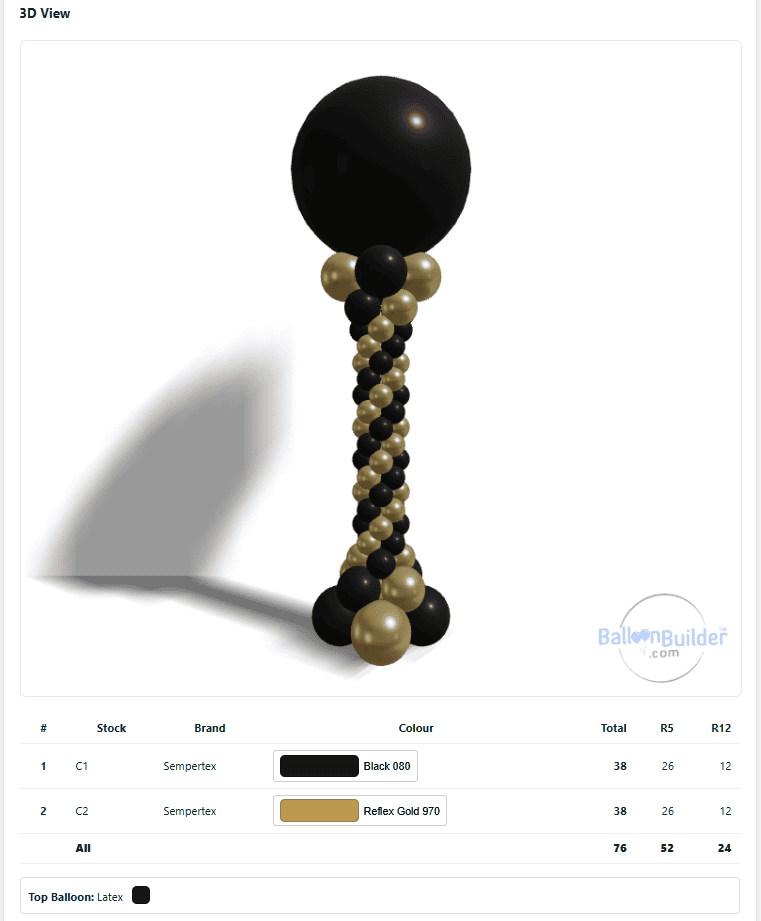
Stop guessing your prices
The free BalloonBuilder Quote Builder calculates your materials, labor, and profit margin in seconds — so every quote you send is backed by real numbers.
Build Your Quote Free →How Do You Calculate Balloons for a Classic Arch?
Measure the arch frame’s total length — not the span — then apply your balloons-per-foot formula. This is where many decorators get tripped up. The arch span (the distance between the two bases) is not nearly the same as the frame length.
Step 1: Determine Frame Length
An arch frame is typically roughly a half-circle. If your arch span is 8 feet and the peak height is 8 feet, the frame length is approximately:
Frame length ≈ π × radius
For an 14ft span with an 8ft peak height: the radius is about 7 feet, giving you a frame length of roughly 21 feet. For most standard single-arch frames from suppliers, the frame length is printed in the product specs — use that number.
For a quick estimate on a standard semi-circular arch: Frame length ≈ (Span × 1.6) to (Span × 2.0), depending on how tall the arch is relative to the span.
Step 2: Apply Balloons Per Foot
Once you have the frame length, it’s the same math as a column:
- 12″ balloons (inflated to 8″) on a 16ft frame: 16 × 8 = ~120 balloons
- 5″ balloons on a 16ft frame: 16 × 16 = ~256 balloons
Step 3: Account for the Base
If your arch has decorative base clusters or column bases, add those separately. Two 2-foot column bases at 7 balloons/foot = 28 extra balloons. This would result in a straight-sided arch, where columns are straight and the top part is arched between the two columns.
Total for a standard 8ft-span classic arch with short column bases (12″ balloons): ~120 + 28 = ~148 balloons
See also: How Much To Charge For A Balloon Arch
Spiral and Alternating Patterns
The pattern doesn’t change the count — it changes the color distribution. A two-color spiral on a 16ft frame still needs ~120 balloons, but you’d order ~60 of each color. A four-color pattern: ~30 of each. Always round up per color and add your breakage buffer. Obviously, the count of balloons you need to buy, depends also on the size of bags, so you may need to calculate full bags when calculating the material costs.
What’s the Formula for Organic Garland Balloon Counts?
Organic garlands use a mix of sizes — typically 5″, 12″, 18″, and 24″. This is the most variable formula because organic work is, by definition, irregular. But you still need a reliable starting estimate for ordering.
The Baseline Formula
For a moderately dense organic garland/column:
- 10-foot garland = 80 – 120 (mixed sizes of 12″ and 18″), without calculating the 5″ clusters, that are often added after building the garland
- That works out to roughly 8 – 12 balloons per linear foot
When you add the 5″ balloons into the mix, the total number of balloons depends on how many clusters (typicall 3 or 4 balloons per cluster). The total number of balloons (5″ – 18″) can typically be something between 120 – 200 balloons. This obviously depends on the structure of the organic column (if you add 5″ garlands around the column, the number of 5″ balloons may easily duplicate).
Size Mix Ratios
A standard organic garland mix:
| Size | Percentage of Total | Purpose |
|---|---|---|
| 5″ | 25–35% | Fillers, texture, visual depth |
| 12″ | 40–50% | Primary body of the garland |
| 18″ | 15–20% | Focal points, volume |
| 24″ | 2–5% | Statement pieces, anchors |
For a 150-balloon, 10ft garland, that breaks down to roughly:
- 5″: 40–50 balloons
- 12″: 60–75 balloons
- 18″: 25–30 balloons
- 24″: 3–7 balloons
Density Levels
Not every garland is created equal. Here’s how density changes your count:
- Light/airy garland (minimal layering): ~100 balloons per 10ft
- Standard density (good coverage, some depth): ~140–160 per 10ft
- Ultra-dense/lush (deep layering, no gaps): ~180–220 per 10ft
The density you promise in your design mockup is the density you need to order for. This is one of the biggest sources of quoting errors in organic work — showing a client a lush, dense garland photo and then ordering for standard density.
Design this in BalloonBuilder
Build your balloon designs in 3D, get exact balloon counts by size and color, and generate client-ready proposals — all before you inflate a single balloon.
Start Designing →Accounting for Curves and Corners
Straight garlands are the baseline. Every curve, corner, or dimensional feature adds balloons:
- 90° corner: Add 10 – 20 extra balloons per corner
- Gentle curve (over a doorway): Add 10% to that section
- 3D dimensional cluster (a “bump out”): Add 5 – 20 balloons per cluster
For a 20-foot garland over a doorway with two corners and one statement cluster:
- Base: 20ft × 15 balloons/ft = 300 balloons
- Two corners: 2 × 18 = 36
- Statement cluster: 25
- Total: ~361 balloons, round to 375 with breakage buffer
📌 A word on organic formulas: Organic columns, garlands, and arches can be built in so many different ways — varying density, size mixes, layering depth, and personal style — that no formula will be perfectly accurate for every decorator. These numbers are a solid starting estimate, but the best thing you can do is document your first organic builds carefully. Take photos, measure the finished length, and count exactly how many balloons of each size you used. That real-world data becomes your personal recipe book — and it’s far more reliable than any formula for pricing your next job.
How Do You Calculate Balloons for a Balloon Wall?
A 12″ balloon inflated to 8″ covers roughly a 8″ × 8″ area. Divide your wall dimensions by the balloon coverage to get your count — then adjust for your packing pattern. Balloon walls are one of the most material-intensive designs, so getting this formula right has the biggest impact on your COGS. Designing and calculating balloons for a balloon wall is very fast using dedicated balloon design software.
Design this in BalloonBuilder
Build your balloon designs in 3D, get exact balloon counts by size and color, and generate client-ready proposals — all before you inflate a single balloon.
Start Designing →Understanding Duplet Square Pack
Each “unit” in a duplet square pack balloon wall is a duplet — two balloons tied together, one facing the audience and one behind (basically not visible). This means:
- Every visible balloon has an “invisible” twin behind it
- Your total balloon count is always 2× the number of visible positions
- 12″ balloons are typically inflated to 8″ for walls (tighter sizing and round shape creates a seamless surface)
This is the most common mistake in wall calculations for beginners: counting only the front-facing balloons and forgetting the back layer.
Wall Formula
For 12″ balloons inflated to 8″ in a duplet square pack:
- Visible positions = columns × rows (based on wall dimensions)
- Total balloons = visible positions × 2
Here are reference dimensions from real-world builds:
| Grid Size | Wall Dimensions | Total Balloons (duplet) |
|---|---|---|
| 2 × 2 | 37cm × 50cm (15″ × 20″) | 8 |
| 4 × 4 | 72cm × 90cm (28″ × 35″) | 32 |
| 8 × 8 | 141cm × 170cm (56″ × 67″) | 128 |
Wall Count Quick Reference (Standard Sizes)
Extrapolated from the reference data above for common wall sizes using 12″ balloons at 8″:
| Wall Size | Approx. Grid | Total Balloons (duplet) |
|---|---|---|
| ~5ft × 5ft | 8 × 7 | 112 |
| ~8ft × 8ft | 14 × 12 | 336 |
| ~10ft × 10ft | 18 × 15 | 540 |
Double-Stuffing on Walls
Double-stuffing (inserting one balloon inside another for a richer color or custom shade) doesn’t change your position count — it doubles your balloon units per position. A duplet wall position with double-stuffed balloons uses 4 balloon units per position instead of 2.
Also note: double-stuffed balloons inflate to a slightly smaller diameter using timed inflators because of the extra latex layer.
Other Balloon Wall Styles
The duplet square pack is the most common wall structure, but it’s far from the only one. Balloon walls come in many different construction methods, each with a different look, balloon count, and build time. Here are a few examples:


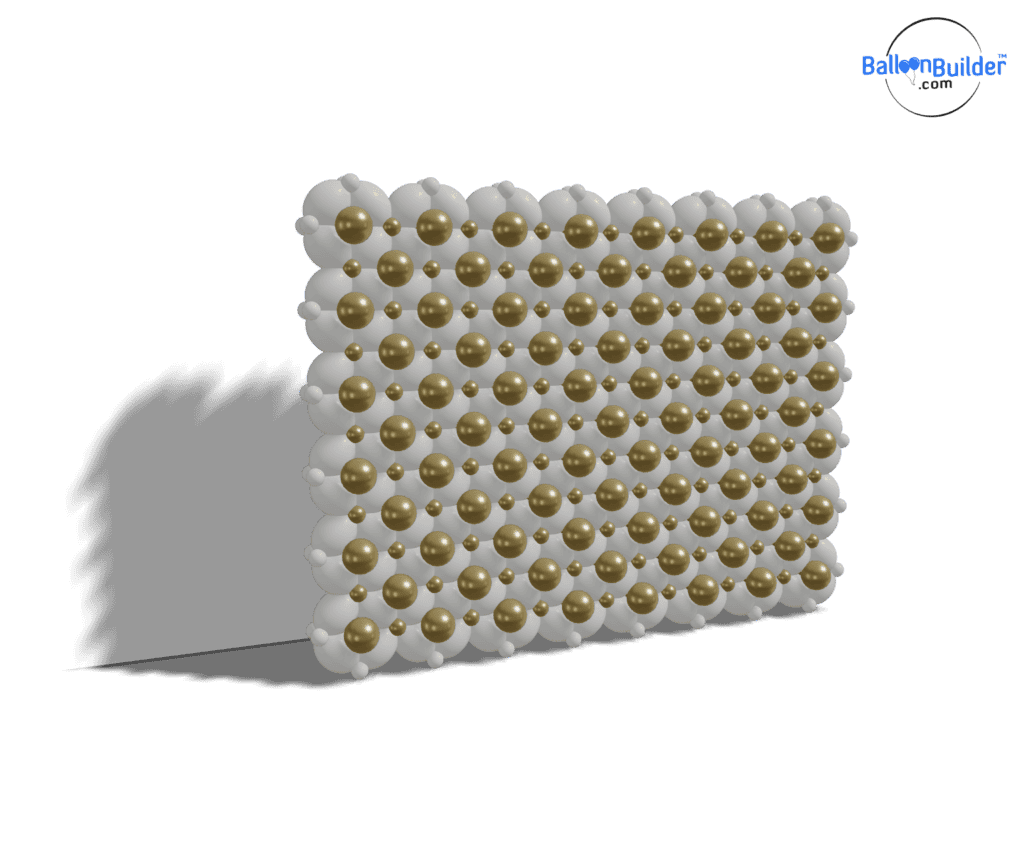
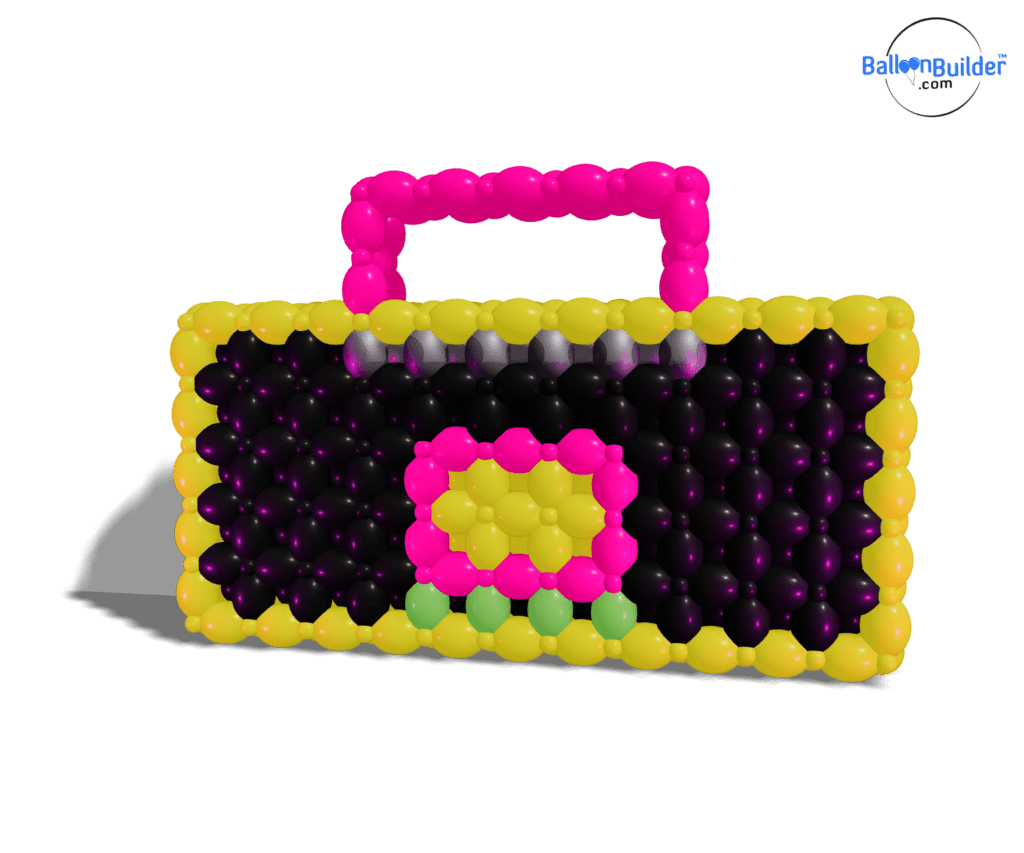
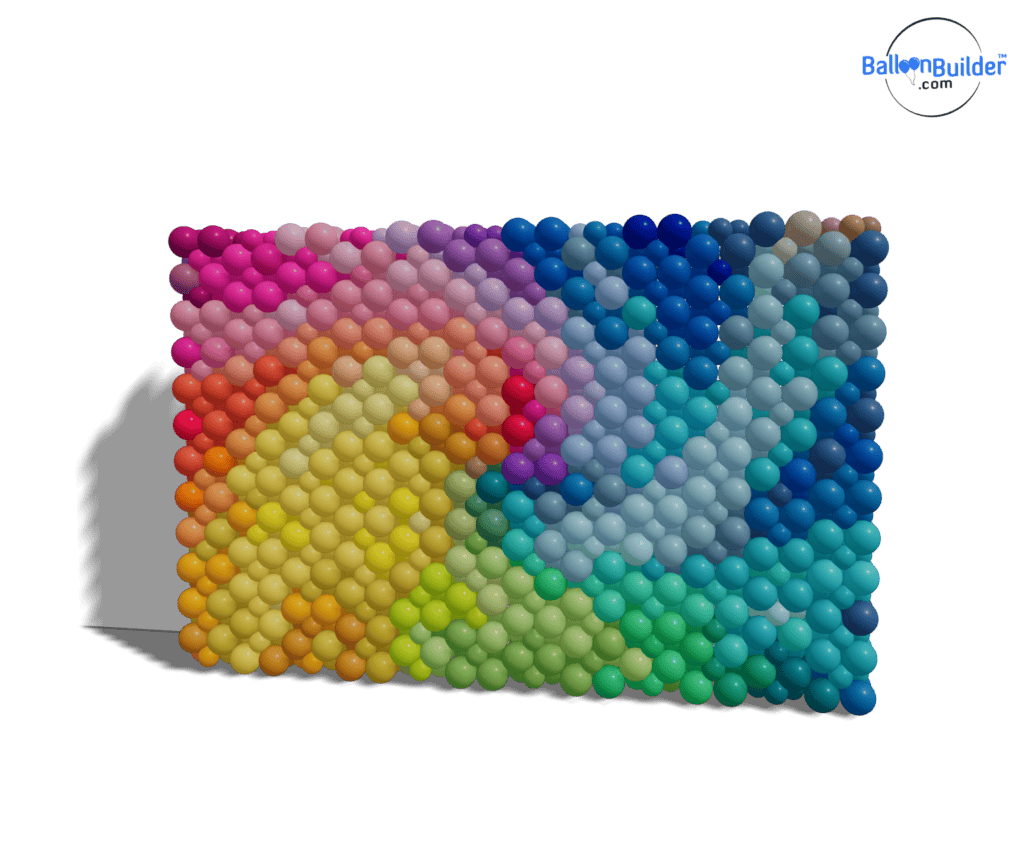
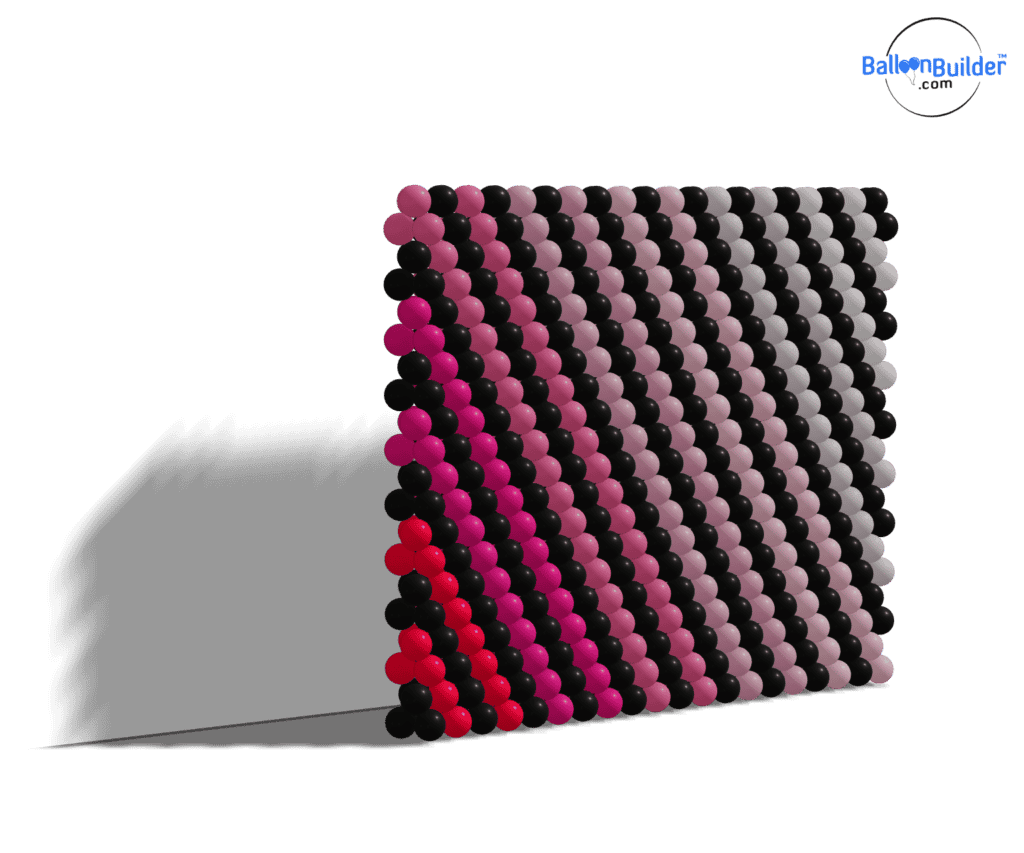
Each of these structures uses a different number of balloons per square foot, different balloons (round or linking balloons) and requires different build techniques. The formulas above apply specifically to the duplet square pack — if you’re building a different wall style, your counts will vary. As with organic garlands, the best approach is to document your first build of each style and use those real numbers for future quoting. Specific software, like BalloonBuilder.com, to create the design will make it much faster to create the balloon wall in specific size and style.
Design this in BalloonBuilder
Build your balloon designs in 3D, get exact balloon counts by size and color, and generate client-ready proposals — all before you inflate a single balloon.
Start Designing →How Does Oversizing or Undersizing Affect Your Balloon Count?
Every inch of inflation difference changes your per-foot count. This seems obvious, but it’s the #1 source of “the math was right but the design looks wrong” problems.
What Happens When You Oversize
Inflating a 12″ balloon to 12″ instead of 8″:
- Fewer balloons per foot — your quads are fatter, so fewer fit per linear foot
- More breakage risk — latex stretched past optimal inflation pops faster, especially in heat
- Color becomes translucent — the latex thins, making deep colors look washed out
- Shorter display time — over-inflated (or fully inflated) latex degrades faster and pops more easily
A 12″ balloon at 12″ inflation? You might only need 5 per foot instead of 7. Sounds like savings — but the column will look amateur, the color will be off, and you’ll get callbacks. For example duplet square pack wall does not look good with over inflated balloons – it will have gaps and the surface is more bumpy.
What Happens When You Undersize
Inflating a 12″ balloon to only 6″–7″:
- More balloons per foot — tighter packing, more material
- Richer color — thicker latex wall means deeper, more saturated hues
- Longer lasting — under-inflated balloons resist oxidation and hold up better outdoors
- Less shiny — under-inflated balloons will not be as shiny, so you may need to push the air to the end of the balloon manually to keep the look professional
- More labor — you’re tying more duplets and stacking more quads for the same height – also the manual manipulation required to keep the shine will increase your labor time
Intentional undersizing is a valid technique, especially for [INTERNAL LINK: outdoor balloon decor tips] where longevity matters. Just make sure you adjust your count and your quote accordingly.
The Sizer Is Non-Negotiable
Use a balloon sizer (a rigid template with a cutout matching your target diameter) for every single balloon in classic work. Alternatively, a timed inflator will make it much faster to consistently size your balloons. When using timed inflator and several different balloon brands and textures, be aware that some brands are less stretchy and for example metallic and satin balloons are typically harder to inflate, which may affect the sizing. For organic garlands, you have more latitude. For classic designs, inconsistency in inflation is more damaging to the finished look than being slightly over or under your target.
What’s the Old Way vs. the New Way of Calculating Balloon Counts?
The “old way” is a calculator, a notepad, and years of experience memorizing per-foot rates. The “new way” is letting design software do the math for you — instantly and accurately. Both get you to the same place, but one of them requires years of experience and the other takes only seconds – sometimes minutes and is basically a side product of creating the design (2D and 3D image of the finished design).
The Manual Math Workflow
Here’s what the manual process looks like for a moderately complex job — say, two 7ft columns, one 8ft arch, and a 15ft organic garland:
Columns (×2):
- 7ft × 8 balloons/ft = 52 per column
- × 2 columns = 104 balloons
- Split by color (2-color spiral): 52 Color A, 52 Color B
Arch:
- 12ft span, ~17ft frame length (half circle shape)
- 17 × 8 = 132 balloons
- Plus two 2ft bases: 28
- Total: 160 balloons
- Split by color (4-color): 40 each
Organic garland:
- 15ft × 15 balloons/ft (standard density) = 225
- Size split: 56 × 5″, 112 × 12″, 38 × 18″, 7 × 24″
- Each size split across 4 colors…
You can see how this gets tedious. And error-prone. And slow when the client calls back wanting to change the garland to 20 feet and add a third column.
The BalloonBuilder Workflow
In BalloonBuilder, you set your design parameters — number of balloons per layer (for typical balloon column, this is 4 – 6 balloons), number of layers, edit layer sizes (or choose one of the templates) — and the software calculates your exact balloon count by size and color automatically. Change the garland from 15 feet to 20 feet? just increase the number of layers and take a look at the dimensions. The balloon count updates in real time. Swap a color? The per-color breakdown adjusts instantly. In the 2D image and export options, you can also view the balloon sizes in 2D image and even the timer settings for a specific inflator (in the example, the timer settings are given for Lagenda B322 inflator).
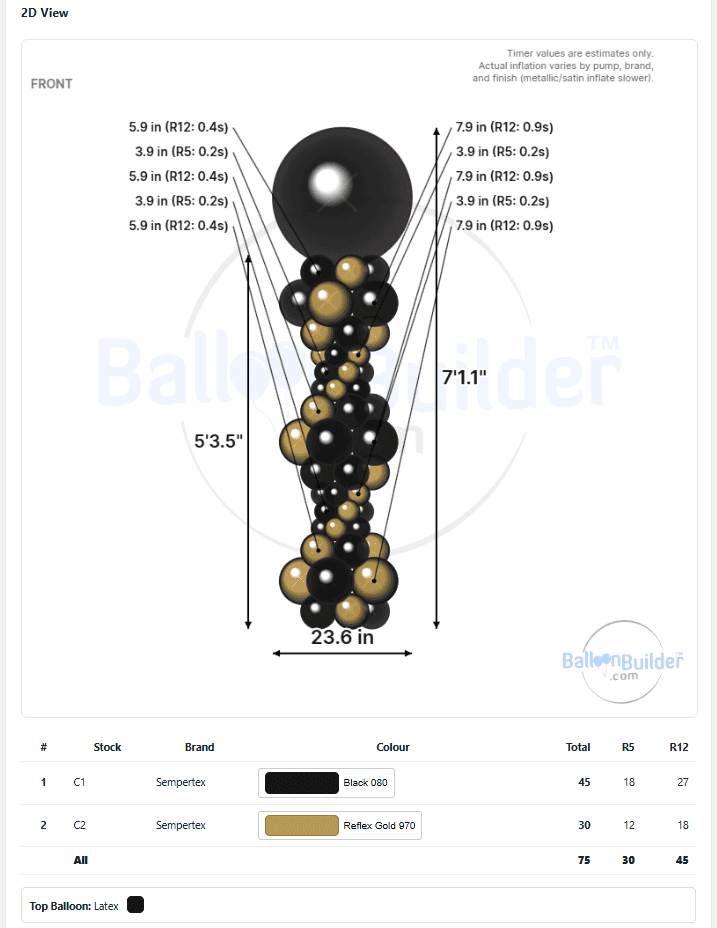
This isn’t about replacing your knowledge — it’s about not having to redo the same arithmetic on every quote. You still need to understand the formulas (which is why you’re reading this article). But once you understand why the math works, letting software handle the execution frees you up to focus on design and client communication.
How Do You Build in a Breakage and Waste Buffer?
Add 5–10% to your total count for classic designs and 10–15% for organic garlands. This covers popped balloons, rejects (misshapen, inconsistent color, pinhole leaks), and the inevitable few you’ll lose during install. When using high quality balloons, rejects are typically minimal, but it is still good to have some extra – especially if you need to move the designs a lot after building them.
Buffer Guidelines by Design Type
| Design Type | Recommended Buffer | Why |
|---|---|---|
| Classic column | 5–10% | Controlled environment, consistent sizing |
| Classic arch | 5–10% | Same as column, slightly more handling |
| Organic garland | 10–15% | Multi-size mixing, more handling, more waste |
| Balloon wall | 5–10% | Grid work is systematic, fewer surprises |
| Outdoor install | 15–20% | Heat, wind, UV — balloons pop more often |
The Real Cost of Not Buffering
If a 20ft garland takes you 2 hours to build and your shop rate is $50/hr, running out of balloons mid-install means:
- Emergency supply run: 30–60 minutes of lost time = $25–$50
- If supplier is closed: you’re short-delivering or improvising with the wrong colors
- Client perception: you didn’t plan properly
Compare that to the cost of the buffer: 15% extra on 300 balloons = 45 balloons × $0.12 = $5.40. Buffer every time.
How Do Brand Differences Affect Your Balloon Formulas?
Different manufacturers produce balloons with slightly different inflated diameters at the same nominal size. A Tuftex 12″ and a Sempertex 12″ may differ in size at the same timer setting. Also the shape of different brands may differ – especially if inflating closer to the full size. This matters for classic work where consistency is everything.
- Tuftex: Excellent quality and consistency. Some decorators find they inflate slightly larger than other brands at the same fill. Great color selection including the Effects (chrome) line. Considered often the best brand for outdoor installs.
- Sempertex: Excellent color range, especially the Reflex (chrome) and Fashion lines. Slightly thinner latex — size carefully. Easy to tie and consistent quality.
- Kalisan: Good value, solid color lineup including the Mirror (chrome) finish. Some color variation between production batches. Thicker and harder to inflate.
The fix: Don’t mix brands within the same classic design element (at least don’t replace the color in the middle of the design with another brand) due to slight color, shape or texture variations between brands. Use one brand per column, per arch. For organic garlands, mixing is less of an issue because the irregularity is the point — but keep your primary fill balloons consistent. If under-inflating, mixing brands in classic designs is not a problem – just be aware of the shape and timer setting differences.
When calculating formulas, always base your per-foot count on the actual inflated size you achieve with your chosen brand, not just the nominal size printed on the bag. A Sempertex 12″ inflated to 9.5″ needs a different count than a Tuftex 12″ inflated to 10.5″.
Frequently Asked Questions
How many balloons do I need for a 10-foot organic garland?
A 10-foot organic garland typically requires 120–180 balloons of mixed sizes (5″, 12″, 18″, and a few 24″), depending on density. A standard-density garland averages about 140–160 balloons. Ultra-lush garlands with deep layering can push past 200.
What’s the most common mistake in balloon count calculations?
Confusing arch span with frame length. An 8-foot arch span has roughly 17 feet of frame. If you calculate balloons based on 8 feet instead of 17, you’ll be short by more than half. Always measure or look up the actual frame length.
Do I need different formulas for air-filled vs. helium-filled designs?
The balloon count formulas are the same — they’re based on inflated diameter, not inflation method. However, helium-filled balloons are typically inflated to a slightly larger size for adequate lift. If you’re sizing helium-filled 12″ balloons to 12″ instead of 10″, you’ll need fewer per foot. Adjust accordingly and always use your sizer. Just be aware of the durability of balloons, when fully inflated – they can withstand less manipulation when inflated fully. Also, if you inflate balloons with helium, they will deflate much faster (especially if not using treatments like Hi Float, which extends the float time and keeps helium balloons inflated much longer – in some cases, you may also want to use treatment with air inflated designs).
How do I account for 260s (twisting balloons) in my count?
260s are used as connectors, accents, or sculptural elements — not typically as primary structural balloons in decorations. They don’t follow the per-foot formulas above. For garland accents, budget 2–4 260s per foot of garland as a starting point. For bow or ribbon details, estimate based on the specific technique.
Should I include balloon count on my client quote?
Including the total balloon count adds perceived value and transparency. It shows the client that the price is based on real materials and labor, not arbitrary numbers. Some decorators list counts by size (“300 balloons including 12″ and 5″ latex, plus two 24″ statement balloons”) to further justify the investment.
✉️ Get Pro Tips in Your Inbox
Join balloon decorators who get weekly pricing strategies, design tips, and industry insights — free, no spam.
Subscribe →