BalloonBuilder.com
Designed by balloon pros, for balloon pros
A free balloon arch calculator that also counts columns, balloon walls and ceilings. Pick a balloon size, enter the span, height or wall size, and you get the balloon count, the real measurements and a layout you can print. No signup needed. Log in with a free account if you also want to colour the balloons by hand.
🎈 Need real manufacturer colours and a 3D view of the design? See the full BalloonBuilder software →
Every image is a direct export from the BalloonBuilder design tools. Only cropping was done after the export.
Free plan available, no card required to try the 3D designers.
⚠ Dimensions are approximate. Actual sizes may vary depending on inflation level, connection tightness and balloon shapes.
This free calculator gives you quick math estimates. For full 3D visual previews, multi-size organic garlands, and exact manufacturer colors from Gemar, Tuftex, Sempertex, and Kalisan, explore our 3D design suite. (One subscription includes Arches, Columns, Garlands & Walls!)
All 3D images were exported directly from BalloonBuilder.com.
Three things decide the balloon count: the arch span, the balloon size and the cluster type. A standard arch is built from 4-balloon clusters (quads) stacked along a frame, each one turned 45° from the last, which gives the classic spiral.
The balloon arch formula behind it is Balloons = (Arch Length ÷ (Balloon Diameter × 0.8)) × 4. Arch length is the full centre line of the frame, not the span, and the 0.8 is there because the clusters sink into each other.
Put your span into the balloon arch calculator above and you get the count, the arch height and the length of the frame. A 3 m (10 ft) half-circle arch with 11" balloons inflated to 8" takes about 104 balloons. Double the span to 6 m and it's about 220.
This page is the calculator: span and balloon size in, cluster count out. If you want to design the arch rather than just count it (other arch styles, cascading sizes, real manufacturer colours), that's the balloon arch maker, which shows the arch in 3D and exports it for the client.
For a classic spiral arch with 11" or 12" balloons inflated to about 8" (20 cm), count on roughly 25 balloons per metre of frame, or about 8 per foot. Measure along the curve of the frame, not across the bottom, because the curve is always longer than the span. A half-circle frame is about 1.4 times as long as it is wide.
That gives these rough totals for a half-circle arch:
Smaller balloons need more of them: the same 10 ft arch takes about 172 balloons with 5" balloons. An organic arch (a garland on a frame, with mixed sizes) takes far more, usually 25–40 balloons per foot of frame, so a 10 ft wide organic arch can easily need 350–550. Add 10–15% extra for pops and for balloons that come out the wrong size.
For your exact frame, choose Arch in the calculator above and enter the span. The full table by balloon size is further down the page.
All 3D images were exported directly from BalloonBuilder.com.
A column (people also call them balloon towers) is a stack of quads, each layer turned 45° from the one below. The layers press into each other by about 20%, so the height formula is Height = ((layers − 1) × diameter × 0.8) + diameter.
For a 6-foot column with 11" balloons inflated to 8" (20 cm), you need 11 layers, so 44 balloons. Go to 12 layers and you reach 196 cm (6.4 ft) with 48 balloons. Use a heavy base, especially outdoors.
Most columns are built with 11" or 12" balloons at 8"–9". Small table columns work with 5" balloons, and tall columns for big rooms often use 16" or 18" balloons, which need fewer layers for the same height. The size dropdown above goes from 4" to 12" inflated size.
For balloon column patterns (2, 3 and 4 colour spirals, stripes, diamonds), cascading sizes or linked columns, the 3D Column Designer has 15+ modes and shows the column in 3D.
All 3D images were exported directly from BalloonBuilder.com.
The calculator does two wall patterns. Duplet Square Pack puts round balloons in a tight hexagonal grid: width = columns × balloon diameter, height = rows × diameter × 0.866. X-Pattern uses Link-O-Loon (LOL) balloons in X-shaped clusters, with round balloons where the links meet.
An 8 × 8 ft backdrop can take anything from 200 to 600+ balloons, depending on the pattern and the balloon size, so it's worth measuring before you order.
For letter-shaped walls, custom shapes, double-sided walls or tunnels, use the 3D Wall Designer.
Set the mode selector above to Ceiling and the tool works as a balloon ceiling calculator. Enter the ceiling width and depth, pick a balloon size, and set the fill percentage. It converts your dimensions into a coverage area, divides that by the footprint one balloon occupies at the chosen size, and returns the balloon count for the whole ceiling. It is the same arithmetic you would otherwise do by hand, without the rounding errors. You also get a visual confirmation in the canvas, so you can see how full the ceiling actually looks at the fill percentage you have set before you commit to an order.
A packed ceiling at 100% fill hides the surface completely; a scattered helium ceiling at 40–60% leaves deliberate gaps. A 2 × 3 m (6.5 × 10 ft) ceiling at 80% fill with 12" (30 cm) balloons comes out at about 53 balloons; drop the fill to 50% and it is closer to 33. That single control is why a ceiling balloon calculator cannot be a fixed table: the same room needs wildly different counts depending on how dense you want it. To plan a helium balloon ceiling in 3D, with ribbon lengths and balloon tops, use the Bouquet & Ceiling Designer.
The results also show a Real Coverage figure: the share of the ceiling actually hidden by balloons, worked out as balloon count × the area of one balloon, divided by the ceiling area. It is always lower than the fill percentage, because round balloons cannot tile a flat surface. Even a fully packed grid covers about 78% of the area, with the rest showing as gaps between the circles. If you need genuine full coverage, plan on overlapping layers or a second size to fill those gaps.
If you want to sanity-check the result: an 11" (28 cm) balloon covers roughly 0.66 sq ft (613 cm²), a 16" (40 cm) about 1.4 sq ft (0.13 m²), and a 3 ft (90 cm) balloon around 7 sq ft (0.65 m²). A scattered helium ceiling averages about 5 balloons per square metre (roughly 0.5 per square foot). So how many balloons to fill a room of 10 × 10 ft (3 × 3 m) works out at roughly 152 balloons of 11" / 12" for full coverage. Both 11" (28 cm) and 12" (30 cm) are selectable in the size dropdown, because the same balloon is sold under both names.
If you are quoting a helium ceiling, work the gas out with the helium calculator as well, because balloon count and helium volume are separate costs.
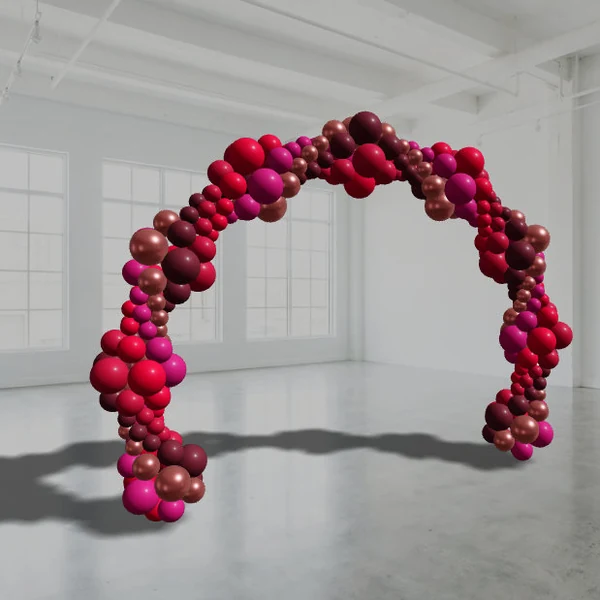
Organic garlands designed and rendered in BalloonBuilder's 3D engine.
Garlands (organic arches) mix 5", 11", 16" and 24" balloons (13, 28, 40 and 60 cm) in a loose, uneven pattern. That's what makes them look natural, and it's also why no simple formula gives an exact count.
Rule of thumb: plan for 25–40 balloons per foot of garland (80–130 per metre). A 10-foot garland usually needs 250–400 balloons, depending on how full it is and how many small balloons you tuck in.
If you want an exact count, the garland designer places every balloon in 3D and lists them by size and colour, and you can show the same picture to the client.
Mosaics are the one shape this free calculator does not cover, and it is worth saying why. An arch, column, wall or ceiling is a line or a grid, so a formula gets you a reliable count. A mosaic is a closed shape packed with mixed balloon sizes, and the total depends on the outline, the font, the frame depth and how tightly the gaps are filled. No reference table answers that honestly, which is why the counts on this page do not transfer to a mosaic.
That work happens in the Mosaic Designer, which is part of the paid Entry, Pro and Full plans rather than this free tool. You type a number, a name or several lines of text and it generates the frame outline and packs it, with six built-in fonts, or you upload your own SVG for a custom shape. Standard heights are one-click presets: 30″ (76 cm), 4 ft (122 cm) and 5 ft (152 cm), or a custom size. The 4 ft is the most common party size and usually takes 2–4 sheets of foam board; a 30″ piece is usually 1–2.
Every design comes with a material list broken down by balloon size and colour, using real product colours from Tuftex, Sempertex, Kalisan and Gemar, plus printable build templates. See what the Mosaic Designer does →
Worth being straight about the difference, because the free tools and the paid designers are not the same product and are not meant to be compared like for like.
This page does: arch, column, duplet wall, X-pattern wall and ceiling-fill counts, with real measurements in cm or feet, a layout preview, and PNG/PDF export. Free, no account, no calculation limits.
This page does not: render in 3D, mix balloon sizes into organic garlands, pack mosaic shapes, apply real manufacturer colours, produce material lists broken down by colour, or generate a watermark-free client proposal. Those are the paid designers, not a limitation you can work around by using the calculator harder.
For 3D rendering, organic garlands, manufacturer colour libraries (Gemar, Tuftex, Sempertex, Kalisan) and client-ready exports, compare the full plans, from $14.90/month with a 14-day free trial.
Short answers to the questions decorators ask most about arches, columns, walls and garlands.
For a classic spiral arch with 11" or 12" balloons inflated to about 8" (20 cm), plan on about 25 balloons per metre of frame (about 8 per foot), measured along the curve. A 10 ft (3 m) wide half-circle arch takes about 104 balloons, a 6.5 ft (2 m) arch about 64 and a 20 ft (6 m) arch about 220.
An organic arch with mixed sizes takes much more, usually 25–40 balloons per foot of frame. Add 10–15% extra either way, and use the calculator above for your exact span.
The standard balloon arch formula for quad-cluster (spiral) arches is: Balloons = (Arch Length ÷ (Balloon Diameter × 0.8)) × 4. Arch length means the full centre line of the frame, not just the span, and the 0.8 factor accounts for cluster nesting, the same compression used in the column formula.
Example: a 2 m span half-circle arch has a centerline length of about 2.6 m. With 11" balloons inflated to 8" (20 cm): 260 ÷ 16 = 16.25 clusters → ~64–68 balloons. The calculator above applies this automatically with proper rounding.
The standard balloon column formula is: Height = ((Layers − 1) × Balloon Diameter × 0.8) + Balloon Diameter. The 0.8 factor accounts for physical cluster compression. Total balloons = Layers × 4 (for standard 4-balloon quad clusters).
Example: 10 layers of 11" balloons inflated to 8" (20 cm) = (9 × 20 × 0.8) + 20 = 164 cm (5.4 ft) using 40 balloons.
For a duplet balloon wall, calculate dimensions using: Width = Columns × Balloon Diameter and Height = Rows × Balloon Diameter × 0.866 (where 0.866 accounts for hexagonal row nesting).
Example: An 8-column × 10-row wall using 11" balloons inflated to 8" (20 cm) measures 160 cm wide × 173 cm high (5.2 ft × 5.7 ft) and uses 160 balloons (80 duplets).
A balloon arch is built on a rigid curved frame using uniform-sized balloons in symmetric quad clusters. A balloon garland (organic arch) has no rigid frame, is attached directly to walls or backdrops, and mixes multiple balloon sizes (5", 11", 16", 24") for an organic look.
Garlands need 30% to 50% more balloons for the same linear span. For 3D organic designs, use BalloonBuilder's 3D Garland Designer.
A column stands on a vertical pole support; an arch is built over a curved frame spanning an entrance; and a garland is a frameless, flexible balloon strand draped across walls, ceilings, or backdrops.
Because each structure uses different geometry and cluster types, balloon counts differ significantly between them for the same physical space.
Yes, in practical decorating use. US brands (such as Qualatex) label the standard round latex balloon as 11", while European and Latin American manufacturers (Gemar, Sempertex, Kalisan) label the exact same balloon size as 12" (30 cm).
Inflated diameters differ by only ~1–2 cm, which falls well within normal inflation variation. Calculations for 11" and 12" are fully interchangeable.
11" or 12" latex under-inflated to 8"–9" (20–23 cm) is what most decorators use for both columns and arches. Slightly under-inflated balloons are rounder, pack more evenly and cope better with temperature changes.
For small table columns, 5" (13 cm) balloons work, but you need about three times as many. For tall columns in big venues, 16"–18" (40–45 cm) balloons reach the height with fewer layers. Organic garlands mix 5", 11", 16" and 24".
Standard sizes in cm: 5" = 13 cm, 11" = 28 cm, 12" = 30 cm, 16" = 40 cm, 18" = 45 cm, 24" = 60 cm, 36" = 90 cm.
Yes, 100% free with no account required for arches, columns, duplet walls, X-pattern walls, and ceiling fills with zero calculation limits. The manual color palette is unlocked with a free login.
For full 3D rendering, organic garland design, exact manufacturer colors (Gemar, Tuftex, Sempertex, Kalisan), and printable client exports, BalloonBuilder offers a 14-day free trial.
Yes. This page returns counts and measurements only. The paid BalloonBuilder designers render the same structures in real-time 3D with 15+ design modes, real manufacturer colour catalogues, automatic material counting and client-ready PDF proposals. Plans start at $14.90/month with a 14-day free trial.
Quick reference for common sizes. Based on standard quad-cluster (4-balloon) half-circle arches and columns. Balloon size shown is inflated size (e.g., 11" balloon inflated to 8"). Always order 10–15% extra. Use these tables as a quick balloon arch size guide, or export your own numbers as a printable PDF from the calculator above.
| Span | Height | Linear Length | 5" balloons | 8" (20cm) | 10" (25cm) |
|---|---|---|---|---|---|
| 2m (6.5 ft) | 1.0m | 2.6m | ~112 | ~64 | ~48 |
| 3m (10 ft) | 1.5m | 4.1m | ~172 | ~104 | ~80 |
| 4.5m (15 ft) | 2.25m | 6.5m | ~268 | ~160 | ~128 |
| 6m (20 ft) | 3.0m | 8.8m | ~364 | ~220 | ~172 |
| Layers | Height (8"/20cm) | Balloons |
|---|---|---|
| 6 layers | 100 cm (3.3 ft) | 24 |
| 8 layers | 132 cm (4.3 ft) | 32 |
| 10 layers | 164 cm (5.4 ft) | 40 |
| 12 layers | 196 cm (6.4 ft) | 48 |
| 15 layers | 244 cm (8.0 ft) | 60 |
| Length | Mixed Sizes (Organic) | Single Size (11") |
|---|---|---|
| 5 ft / 1.5 m | 125–200 | ~80 |
| 8 ft / 2.4 m | 200–320 | ~128 |
| 10 ft / 3 m | 250–400 | ~160 |
| 15 ft / 4.5 m | 375–600 | ~240 |
| 20 ft / 6 m | 500–800 | ~320 |
Built by a pro: BalloonBuilder is designed by a professional balloon decorator. All calculations use standard quad-cluster methods and account for physical balloon compression (GAP factor ~0.80).
Last updated: 27 September 2026
BalloonBuilder provides free tools for balloon professionals:
BalloonBuilder is professional balloon design software with real-time 3D rendering, 15+ design modes, automated counting, and client-ready exports. Plans from $14.90/month.
The full BalloonBuilder software adds 3D rendering, organic garlands, real manufacturer colours and exports you can send to clients. Every plan starts with a 14-day free trial, no card needed.
Start Your Free Trial →Handy tools from other makers in the event industry.
Marquee Letter Calculator Type the phrases you rent out and see exactly which letters, numbers and symbols you need to own. by Asset Assign