
BalloonBuilder.com
Designed by balloon pros, for balloon pros

Work out how many balloons a helium tank fills, how much helium each balloon size needs, and what it costs per balloon. EU and US tank sizes, float times and helium/air mixes are built in. No signup.
🎈 Need to design the decorations too? Balloon Arch Maker →
⚠ Volume note: Balloon volumes depend on the manufacturer: dimensions vary between brands, and the reported size (e.g. 12") may not always match the actual inflated diameter. Values shown are based on Sempertex (latex) and Grabo (foil) specifications.
⚠ Float time note: Every float time here is a typical figure for an untreated balloon, with no Hi-Float or similar sealant. Treated latex lasts substantially longer. Real float time also depends on where and when you are working: temperature, humidity, altitude and air movement all move it, so the same balloon can behave quite differently indoors in winter than outdoors in summer, and a figure that holds in one venue may not in the next. Manufacturer and material weight matter too. Treat these as planning estimates, not promises, and test with your own stock if the timing is critical.
⚠ Party tank note: Disposable party tanks from some manufacturers may contain helium that is less than 100% pure (80% purity is common), which can reduce float time compared to professional-grade cylinders.
Always order 10–15% more helium than calculated to account for gas loss and inflation variations.
Our free Quote Builder includes a built-in helium calculator. Create professional balloon event proposals with material pricing, margin analysis, and PDF export.
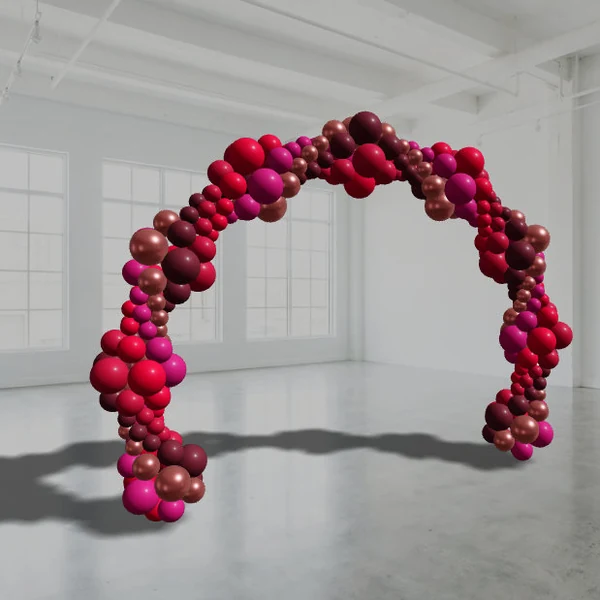
Every image is a direct export from the BalloonBuilder design tools. Only cropping was done after the export.
Free trial available, no card required to try the 3D designers.
Worth being straight about the difference before you judge one by the other.
This free helium calculator gives you gas volumes and tank counts. For full 3D previews, multi-size organic garlands, and exact manufacturer colours from Gemar, Tuftex, Sempertex, and Kalisan, explore the 3D design suite. (One subscription includes Arches, Columns, Garlands & Walls!)
The short version, one line each. Full tables, tank charts and the live calculator are above and below.
A 9-inch (23 cm) latex balloon holds about 7 litres (0.25 cu ft) of helium and floats for roughly 9 hours. A 20 L tank fills about 531 of them.
An 11-inch (28 cm) latex balloon holds about 11.5 litres (0.41 cu ft) of helium and floats for roughly 14 hours. A 20 L tank fills about 323 of them.
A 12-inch (30 cm) latex balloon holds about 15 litres (0.53 cu ft) of helium and floats for roughly 16 hours. A 20 L tank fills about 248 of them. In most catalogues 11″ and 12″ are the same balloon under two labels.
A 16-inch (40 cm) latex balloon holds about 42 litres (1.48 cu ft) of helium and floats for roughly 30 hours.
A 24-inch (60 cm) latex balloon holds about 110 litres (3.88 cu ft) of helium and floats for roughly 60 hours.
A 36-inch (90 cm) latex balloon holds about 400 litres (14.13 cu ft) of helium at full inflation and floats for roughly 5 days. Sempertex rate a 36" to a 30-inch fill instead, which takes only 228 litres. A fully inflated 36" floats poorly for its size and sits close to bursting. A 36″ foil round needs far less, about 80 litres, because foil does not stretch.
Filling 100 standard 12-inch balloons takes about 1,500 litres (1.5 m³) of helium at 100% helium, roughly one 10 L cylinder at 200 bar.
Helium cost per balloon is the tank price divided by the balloons it fills. A €120 20 L tank filling 248 × 12″ balloons works out at about €0.48 per balloon. Enter your own tank price above for an exact figure.
Choosing between 9-inch and 12-inch: a 12″ balloon uses a little over twice the helium of a 9″ (15 L vs 7 L) and floats roughly 16 hours against 9. For a big display on a fixed gas budget, 9″ nearly doubles your balloon count.
A disposable party tank (about 400 L) fills roughly 25 × 12-inch balloons. A 10 L cylinder fills about 124, a 20 L about 248, and a 50 L about 620. All figures include a 7% loss factor.
Pick your tank, add the balloons you're filling, and the helium calculator tells you how many balloons the tank fills and how many tanks the whole job needs. It works for anything from a small disposable party tank to a 50-litre refillable cylinder, and the volumes come from Sempertex (latex) and Grabo (foil) data.
You can mix latex balloons from 5" to 36" (90 cm), foil balloons (18" and 36" rounds, hearts and stars), foil numbers (26" and 40", with a separate volume for each digit), letters and Globe/Orbz balloons in the same calculation. For odd sizes you can type in any diameter up to 240 cm.
If you mix helium with air (60/40 or 80/20), set the mix and the count updates, so you see straight away how much further the tank goes.
In Europe, disposable party tanks are sold by rough balloon count ("20", "30", "50" balloons), usually counted with small 9" balloons. Decorators mostly use refillable cylinders from 10 L to 50 L at 200 bar. A 20-litre cylinder holds about 4,000 litres of helium, which fills roughly 250 standard 12" latex balloons.
In the United States, tanks are sold in cubic feet: disposable party tanks of around 15 cu ft, and rental cylinders from 55 to 291 cu ft. Switch the region in the calculator to compare them. The chart further down lists how many 12" balloons each size fills.
A lot of decorators fill with a helium/air mix to save gas. The common 60% helium / 40% air mix fills 67% more balloons from the same tank, but the balloons float for only about half as long. That's fine for same-day events and indoor work where the balloons don't need to stay up for days.
At 50% helium, standard 11"–12" latex balloons barely float, and below 40% most latex balloons won't stay up at all. Try a few mixes in the calculator to see what each one does to the balloon count.
This page works out the helium. BalloonBuilder is where you design the decorations themselves: arches, columns, organic garlands and walls in 3D, with real brand colours (Gemar, Tuftex, Sempertex, Kalisan), and professional exports. (One subscription includes all 4 core apps!)
Explore 3D Balloon Software →Short answers to the helium questions we hear most: tank sizes, how many balloons a tank fills, and how long it all lasts.
A standard 20-liter refillable helium cylinder at 200 bar holds approximately 4,000 liters of helium. With 12" (30 cm) latex balloons, each needs about 15 litres, which gives you roughly 248 balloons per tank after accounting for a 7% loss factor.
Quick reference: 11" balloons ≈ 323 per tank · 9" balloons ≈ 531 per tank · 16" balloons ≈ 88 per tank · 24" balloons ≈ 33 per tank.
For 100 standard 12" latex balloons at 100% helium, you need approximately 1,500 liters (1.5 m³). A 10L refillable tank (2,000 liters at 200 bar) covers this with room to spare.
Helium/air mix reduces usage: at 60% helium, 100 × 12" balloons only need ~900 liters. For 100 × 18" foil rounds, budget ~1,500 liters. Use the calculator above for precise numbers based on your specific balloon mix.
Helium/air mix inflates balloons with a blend of helium and regular air. A common ratio is 60% helium / 40% air, reducing helium consumption by 40% while still keeping balloons airborne.
Use it for same-day events and indoor installations. At 50% helium, standard 11"–12" latex balloons barely float. Below 40% helium, most latex balloons won't stay airborne.
Float times quoted here are for untreated balloons, with no Hi-Float or similar sealant, and they depend on balloon type, size, helium purity and the conditions on the day:
• 9" latex ≈ 9 hours · 12" latex ≈ 16 hours · 24" latex ≈ 60 hours
• 18" foil ≈ 4 days · 36" foil ≈ 6 days · 19" globe ≈ 15 days
All of the above are for untreated balloons. Hi-Float treatment extends latex float times significantly, and a helium/air mix reduces them roughly proportionally. Conditions matter as much as the balloon does: temperature, humidity, altitude and air movement all shift these numbers, so expect a job in a cold hall in January to behave differently from the same job outdoors in July.
A standard 12" (30 cm) latex balloon requires approximately 15 liters (0.53 cu ft) of helium. This is based on Sempertex manufacturer data at recommended inflation diameter.
Other sizes: 5" = 1L · 9" = 7L · 11" = 11.5L · 16" = 42L · 24" = 110L · 36" = 400L. Note that Sempertex rate a 36" to a 30" fill, which is only 228L, so pick the entry that matches how you actually inflate. See the full reference table below.
Quick guide for 12" latex balloons:
• Small party (20–50 balloons) → disposable party tank
• Medium event (50–200 balloons) → 10L refillable (2,000L)
• Large event (200–500 balloons) → 20L refillable (4,000L)
• Professional install (500+) → 30L or 50L tank
Always order 10–15% more helium than calculated to account for gas loss during filling.
Counting 12" latex balloons, with 7% gas loss included:
• Small (disposable party tank, about 400 L / 15 cu ft) → about 25 balloons, or about 50 small 9" balloons
• Medium (10 L cylinder, or 55–80 cu ft) → about 100–140 balloons
• Large (20 L cylinder, or 125 cu ft) → about 220–250 balloons
Party tanks labelled "50 balloons" usually mean 9" balloons, so expect about half that with 11"–12".
It depends on how many balloons you fill, not on the brand. For one party of 20–30 balloons, a disposable tank is the easy choice. If you fill balloons more than a few times a year, rent a refillable cylinder from a gas supplier instead: the helium costs far less per balloon and it's usually purer.
Check the helium content before you buy a disposable tank. Some contain only around 80% helium, which shortens float time. Then pick the size with the calculator above.
Helium doesn't go off, so a closed refillable cylinder keeps its gas until you use it. Close the valve between jobs, because a regulator left open slowly leaks the tank empty. Disposable tanks are made for one event; once opened, don't count on the rest lasting until the next party.
In use, a tank lasts as many balloons as it holds: a 20 L cylinder fills about 248 × 12" balloons, a 10 L about 124 and a disposable tank about 25.
How much helium does each balloon size need? Use this table for quick estimates. Based on manufacturer data from Sempertex (latex) and Grabo (foil).
| Size (inches) | Size (cm) | Helium (liters) | Helium (cu ft) | Typical float time, untreated |
|---|---|---|---|---|
| 5" | 13 cm | 1.0 L | 0.04 | not rated |
| 9" | 23 cm | 7.0 L | 0.25 | ~9 hrs |
| 10" | 25 cm | 8.0 L | 0.28 | ~11 hrs |
| 11" | 28 cm | 11.5 L | 0.41 | ~14 hrs |
| 12" | 30 cm | 15.0 L | 0.53 | ~16 hrs |
| 16" | 40 cm | 42.0 L | 1.48 | ~30 hrs |
| 18" | 46 cm | 56.0 L | 1.98 | ~30 hrs |
| 24" | 60 cm | 110.0 L | 3.88 | ~60 hrs |
| 30" | 75 cm | 230.0 L | 8.12 | ~96 hrs |
| 36" | 90 cm | 400.0 L | 14.13 | ~120 hrs |
| 36" at 30" fill | 75 cm | 228.0 L | 8.05 | ~96 hrs |
5" balloons are not given a float time. They barely lift their own weight on helium, so anything quoted for them is unreliable. Treat them as air-fill only, or expect them down within the hour.
| Type | Size | Helium (liters) | Typical float time, untreated |
|---|---|---|---|
| Round/Heart/Star | 18" (46 cm) | 15.0 L | ~4 days |
| Round/Heart/Star | 36" (91 cm) | 80.0 L | ~6 days |
| Number / Letter | 26" (66 cm) | 20.0 L | ~4 days |
| Number / Letter | 40" (102 cm) | 55.0 L | ~5 days |
| Globe / Orbz | 11" (28 cm) | 12.0 L | ~10 days |
| Globe / Orbz | 15" (38 cm) | 25.0 L | ~12 days |
| Globe / Orbz | 19" (48 cm) | 50.0 L | ~15 days |
EU tanks are sold in litres at 200 bar and US tanks in cubic feet. Roughly, a small tank is a disposable party tank, a medium tank is a 10 L or 55–80 cu ft cylinder, and a large tank is a 20 L or 125 cu ft cylinder. Balloon counts below are for 12″ (30 cm) latex and include a 7% loss factor.
| Tank Size | Helium Volume | 12" Balloons per Tank | Best For |
|---|---|---|---|
| 2L cylinder | 400 L | ~25 | Small decorations |
| 5L cylinder | 1,000 L | ~62 | Home parties |
| 10L cylinder | 2,000 L | ~124 | Medium events |
| 20L cylinder | 4,000 L | ~248 | Large events |
| 30L cylinder | 6,000 L | ~372 | Professional work |
| 50L cylinder | 10,000 L | ~620 | Large installations |
| Tank Size (cu ft) | Helium Volume (L) | 12" Balloons per Tank | Best For |
|---|---|---|---|
| 14.9 cu ft (disposable) | 422 L | ~26 | Small parties |
| 55 cu ft | 1,557 L | ~96 | Medium parties |
| 80 cu ft | 2,265 L | ~140 | Medium events |
| 125 cu ft | 3,540 L | ~219 | Large events |
| 200 cu ft | 5,663 L | ~351 | Professional work |
| 291 cu ft | 8,238 L | ~510 | Large installations |
Three ways to get helium, and the break-even between them is mostly a question of how many balloons you inflate per year.
Disposable party tanks are the most expensive helium you can buy per balloon. A typical disposable holds around 400 litres (roughly 25 × 12″ balloons), and the cylinder is thrown away. Some brands fill them to less than 100% purity (80% is common), which shortens float time. Fine for a single party, poor value for a business.
Rental cylinders are the standard for working decorators. You pay a refill charge for the gas plus an ongoing cylinder rental, and you return the same cylinder to be refilled. Sizes run from 10 L to 50 L in Europe (2,000–10,000 litres) and 55 to 291 cu ft in the US. Because you are billed for gas rather than for packaging, cost per balloon drops sharply: the 20 L cylinder in the chart above fills about 248 × 12″ balloons against the disposable's 25.
Buying a cylinder outright only makes sense at volume, and in many countries the cylinder itself must stay with a licensed gas supplier for periodic inspection, so outright ownership is less common than decorators expect. Check what your local supplier actually offers before budgeting for it.
Whichever route you take, put the tank price into the calculator above and it will return your real helium cost per balloon. That is the number that belongs in a quote, and the one that tells you when rental starts beating disposables.
Helium (He) is a noble gas and the second-lightest element. Here's why that makes a balloon float.
Air is roughly 78% nitrogen (N₂) and 21% oxygen (O₂), with an average molecular weight of about 29 g/mol. Helium is 4 g/mol, so it's about seven times lighter than the air around the balloon. The heavier air pushes the lighter gas upwards, the same way water pushes a cork up.
In practice, one litre of helium lifts roughly 1 gram. That's the number behind every helium calculation: the balloon floats as long as the helium inside can lift the latex, the ribbon and whatever hangs from it.
Despite being the second most abundant element in the universe, helium is surprisingly rare on Earth. The helium we use in balloons is a byproduct of natural radioactive decay: heavy elements like uranium and thorium, buried deep within the Earth's crust, have been emitting alpha particles (helium nuclei) for billions of years. This helium slowly migrates upward and becomes trapped in underground natural gas deposits, where it is extracted and refined.
Helium is a non-renewable resource. Once it's released into the air it eventually escapes into space, so the supply is limited and the price moves around. That's one more reason to know how much you need before you order.
For decorators, helium is one of the biggest variable costs on a job. Guess too high and you pay for gas you don't use. Guess too low and you run out halfway through inflating.
Temperature matters too. Gas expands in heat and shrinks in cold, so a balloon filled in a cool workshop can look over-inflated at a hot outdoor venue, and one filled in a warm room looks soft in a cold one. Altitude has an effect as well: the air is thinner higher up, so balloons expand more, lift less and pop more easily.
The calculator works from the balloon volumes in the tables above, so you know how much gas a job takes before you order, whether it's 11-inch latex rounds or 36-inch balloons.
📊 Data accuracy: Helium volumes and float times in this calculator are based on Sempertex manufacturer specifications (latex) and Grabo Helium Chart 2023 (foil, number, globe). A 7% efficiency loss factor is applied to all tank calculations to reflect real-world gas loss during filling.
🎈 Built by a decorator: BalloonBuilder is made by a working balloon decorator who fills balloons with helium for events of all sizes, and the numbers have been checked against our own helium use.
📅 Last updated: September 2026
Helium is only half the job. To work out how many balloons a structure needs, use the balloon calculator. It covers arches, columns, walls and ceilings. To design and visualise the structure itself, open the balloon arch maker.
BalloonBuilder is professional balloon design software with real-time 3D rendering, 15+ design modes, automated balloon counting, and export-ready client presentations. Plans start at $14.90/month.
Handy tools from other makers in the event industry.
Marquee Letter Calculator Type the phrases you rent out and see exactly which letters, numbers and symbols you need to own. by Asset Assign